had a patient a number of years ago in my career as a heart surgeon who was 101 years old. He lived on a small farm in Port Townsend, WA, on the other side of Puget Sound from Seattle, with his 96-year-old wife. This fellow, George Crosby, kept up his farm work, which included looking after some cattle and tending a stand of fruit trees and a bean field, until he had so much trouble breathing that he had to be admitted to the hospital. He was in the hospital’s intensive care unit when I met him undergoing treatment for congestive heart failure caused by severe aortic stenosis. His aortic valve had become extremely thickened and scarred, blocking the flow of blood out of his heart. With blood backing up into his lungs, he was now unable to breathe comfortably even with continuous intravenous medications and oxygen. Despite his advanced age I agreed to perform open heart surgery on him and replace the valve. This was the only way he would be able to leave the hospital, alive. Some of my medical colleagues argued that this patient was too old to undergo heart surgery and that he shouldn’t have it. To their surprise, however, this indomitable centenarian came through his aortic valve replacement without any trouble. He left the intensive care two days after his operation. On the 3rd postop day, asked how he was feeling as he walked down the hall unaided, George replied, “I’m not tip top.” He made a smooth, uncomplicated recovery and was discharged from the hospital eight days later. Six weeks later he resumed all his farm chores with renewed vigor.
Awed and inspired by his incredible resilience and spirit, I asked George Crosby to please tell me, if he could, how he had done it. How had he been able to maintain such good health that would enable him to withstand open heart surgery at his age? Without missing a beat, George told me that his philosophy of life was this: “Do unto others as you would have them do unto you—and do it first.” He accepted life as it is and was not given to judgmental thinking. He did not harbor regrets for the past or concerns about the future. He lived in the eternal present. He said that he had wanted to be an engineer but his father put him out to work after the eighth grade, and he worked contentedly at a Pacific Northwest lumber mill. He was quick to forgive but, as his wife later told me, slow to forget. When his son was having difficulties in high school he pulled him out and put him to work logging their property. After a year of this backbreaking work and the boy happily resumed his education, graduated from college and became a bank executive. (This now 76-year-old son was sitting with his mother in the surgical family waiting area when I came out to speak to them after the surgery.)
George Crosby possessed a loving-kindness for all living things, as this photograph of him given to me by his wife showed, taken six months after his heart surgery and shortly before his 102nd birthday. It shows him working in his field, crouched over a trestle of vines, arms outstretched, tending them lovingly with his hands. On seeing this photograph one person remarked, visibly stunned, “Those hands are hands of the earth. And the way he is holding them [the vines]. It is a celebration of life.”
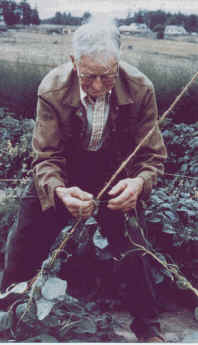 He died two months after this photograph was taken, from complications suffered from a fall off the roof of his barn, one week before his 102nd birthday. He had climbed onto the roof to repair a leak. My wife Linda and I visited his widow at their farm in Port Townsend two and a half years later. Regarding the fatal accident she said, “George was doing so well after his surgery he would have lived for a good while if he hadn’t gone up and worked on the roof of that barn.” She said he always kept busy. He never complained about anything and accepted life as it was. If they had a disagreement about something he would go to the barn and find things that needed to be done until the storm blew over. He rarely watched television. She said he used to like to watch baseball games, but stopped doing that when the player’s desire for ever higher salaries seemed to overshadow their love of the sport. He didn’t complain about it and accepted it for what it was; he just preferred to now spend his time doing something else. She said that he was happiest when he was out in the field tending his crops and vines, or milking his cow. George Crosby lived a simple life that radiated compassion.
Today, people increasingly use the word “compassion” in a loose, careless fashion, particularly in political discourse, where politicians like to say, “I feel your pain”—in the same kind of way that they have usurped the world “liberal,” having made it connote the opposite of what the word classically means. Compassion, correctly defined and understood, is a singularly important concept, one which has philosophical, moral, and medical significance. In my study of this subject, my mentor in philosophy is the 19th Century German philosopher Arthur Schopenhauer; and two important cultural ones are Richard Wagner and Woody Allen.
Compassion embodies two cardinal virtues: natural justice and loving-kindness.
Schopenhauer writes:
Whoever is filled with compassion will assuredly injure no one, do harm to no one, encroach on no man’s rights; he will rather have regard for everyone, forgive everyone as far as he can, and all his actions will bear the stamp of justice and loving-kindness.
This impulse to act justly and to embrace other creatures with loving-kindness is heartfelt and entirely unselfish. Compassion moves a person to come to the aide of another creature, especially one who has experienced misfortune and is in distress, without any self-serving considerations at all. This feeling is directed not just to other human beings but to all living things. Compassion is unconditional love, in its broadest sense.
Schopenhauer’s philosophy is grounded in the view that this irrational force is a manifestation of the innermost reality of life. Compassion is not derived from any rational concepts of duty, laws, or social morality. He writes:
Compassion is an undeniable fact of human consciousness, is an essential part of it, and does not depend on assumptions, conceptions, religions, dogmas, myths, training, and education. On the contrary, it is original and immediate, and lies in human nature itself
The natural justice that compassion embodies is distinct from justice that is framed in laws and enforced by penalties. The fundamental principle of natural justice is do harm to no one. A corollary principle is take from none his own. Our innate compassionate feeling of natural justice counterbalances our self-serving and malicious motives; it keeps us from bringing harm or inflicting injury on another person, or on his or her property or possessions. We live in a world, however, where the competing motive of self-interest presents formidable obstacles to the full expression of compassionate natural justice. So societies have derived a practical form of justice based on legal ordinances and the compulsion of law to maintain peaceful intercourse among competing, self-seeking individuals. The natural justice that arises from compassion, in contrast, is “original and immediate.”
Loving-kindness, the other cardinal virtue of compassion, manifests the deep-seated kinship that each of us has with all fellow creatures. The fundamental principle of loving-kindness is:help all people as far as lies in your power. This impulse makes a person capable of rising to nobleness and magnanimity, where one suffers with another person. This selfless helping of others, Schopenhauer observed, is a mysterious thing. He writes:
For it is one which Reason can give no direct account of, and its causes lie outside the field of experience. And yet it is of daily occurrence. Everyone has often felt its working within himself; even to the most hard-hearted and selfish it is not unknown. Each day that passes brings it before our eyes, in single acts, on a small scale; whenever a man, by direct impulse, without much reflection, helps a fellow-creature and comes to his aid, sometimes even exposing himself to the most imminent peril for the sake of one he has never seen before, and this, without once thinking of anything but the fact that he witnesses another’s great distress and danger.
The loving-kindness of compassion is a central feature of the world’s great religions, especially in Hinduism, Buddhism, and Christianity. Schopenhauer thinks that the great and distinguishing merit of Christianity is that it theoretically formulates and advances loving-kindness as the queen of all virtues. Prior to the advent of Christianity the ancient Greek philosophers, notably Plato, considered justice to be the primary and essential cardinal virtue.
Woody Allen’s film Broadway Danny Rose (released in 1984) is an insightful study of compassion. In it, Danny Rose, played by Woody Allen, is a theatrical manager who handles a motley group of clients, which include, among others, a one legged tap dancer, a blind xylophone player, and an over-the-hill alcoholic Italian night club singer. He is very devoted to his clients and works tirelessly on their behalf. He is tolerant and has a willingness to give. As Danny puts it:
You know I gotta get involved. Like, like my…Herbie Jayson, my bird act. The cat ate the, the lead bird. So, I gotta leap right into the breach, you know. Or my Puerto Rican ventriloquist. The kid’s a wonder, he’s got everything you need to make it big, but he’s a dope addict. So I, you know, I gotta get in there and help.
All his clients join him at his small apartment every Thanksgiving, celebrating it with frozen-turkey TV dinners.
When Danny’s clients get a little success, like the Italian nightclub singer, they leave him. Nevertheless, Danny harbors no bitterness and continues to work hard to see that his other less successful clients do well. He sums up his philosophy of life, which he learned from his late Uncle Sidney, in three words: “Acceptance, forgiveness, and love.”
Given the inherent self-interest of all living things, Schopenhauer asks how is it possible that another’s well-being and suffering should directly affect me? Why do I desire another creature’s well-being just as habitually and immediately as I do for myself and suffer with that person (or other creature) in the same way as I feel my own woe? He writes:
For this to be possible I must in some way or other be identified with him; that is, the difference between myself and him, which is the precise reason for being of my egoism, must be removed, at least to a certain extent….When once compassion is stirred within me, by another’s pain, then his well-being and woe go straight to my heart, exactly in the same way, if not always in the same degree, as otherwise I felt my own. Consequently, the difference between him and myself is no longer an absolute one.
The essential point is that a person who feels compassion “draws less distinction between himself and others than is usually done.” Thomas Merton (1915-1968), the American Trappist monk, religious writer, and poet puts it this way, “The whole idea of compassion is based on a keen awareness of the interdependence of all these living beings, which are all part of one another and all involved in one another.” To put it another way: Compassion arises from our intuitive perception that there is a metaphysical identity and oneness of all beings. It is an automatic, unconscious impulse that springs from the ultimate reality of all living things.
Compassion penetrates the apparent distinction between oneself and others and enables us to dimly perceive the true nature of the world. The central core of Schopenhauer’s philosophy, derived in large part from his analysis of compassion, boils down to this: the essential reality underlying all things is that we are all one and the same entity. Albert Einstein puts it this way:
A human being is part of the whole, called by us “Universe;” a part limited in time and space. He experiences himself, his thoughts and feelings as something separated from the rest—a kind of optical delusion of his consciousness. This delusion is a kind of prison for us, restricting us to our personal desires and to affection for a few persons nearest us. Our task must be to free ourselves from this prison by widening our circle of compassion to embrace all living creatures and the whole of nature in its beauty.
Schopenhauer postulates that the underlying reality of the world—the Noumenon, as he and Immanuel Kant call it—is something like a unified, undifferentiated, insatiable, primal force. We are in the throes of this insatiable root force and intuitively sense it when we have sex. And we experience its unified, undifferentiated nature through compassion. It therefore follows that just as space-time, as our brains are biologically programmed to conceive them, are foreign to the rock bottom reality underlying the cosmos, so also must multiplicity be. Schopenhauer writes:
Individuation is merely an appearance, born of Space and Time; the latter being nothing else than the forms under which the external world necessarily manifests itself to me, conditioned as they are by my brain’s faculty of perception. Hence also the plurality and difference of individuals is but a phenomenon, that is, exists only as my mental picture. My true innermost being subsists in every living thing, just as really, as directly as in my own consciousness it is evidenced only to myself.
So, following Schopenhauer’s line of thought regarding the philosophical importance of compassion, we come, like the Hindus and Buddhists do from a somewhat different approach, to this inescapable conclusion: An undifferentiated singularity underpins the world that we perceive with our biologically constructed intellect and sensory apparatus. All beings and things in the universe are entwined in a cosmic oneness, to use the New Age term for this state. Woody Allen puts it this way, through Boris in Love and Death (1975): “We all relate universally to a great oneness.”
In the 19th century, before Albert Einstein, Niels Bohr, and quantum mechanics, Schopenhauer reached the conclusion from his philosophical musings that “force and substance are inseparable for at bottom they are one.” Then Einstein showed that an object’s mass is equivalent to a specified amount of energy and that at sufficiently high temperatures matter and energy are completely interchangeable. (And in his General Theory of Relativity Einstein interweaves space, time, and gravitation into a single unit, showing that space and time are indivisible from matter and that the structure of space and time depends on the presence and motion of matter.) Discoveries in molecular biology also lend support to the Schopenhauerian/Hindu-Buddhist metaphysical insight that there is an underlying unity of being. All species of living things, from bacteria to humans, use the exact same chemically coded DNA language for the genetic blueprint that determines each organism’s structure and function. And beginning with our ancient bacterial ancestors billions of years ago, all living things use the identical chemical molecule, ATP (adenosine triphosphate), for the energy required to maintain life.
Altruism, in contrast to compassion, is inherently self-serving. A seemingly selfless, altruistic concern for the welfare of others is found, on closer examination, to be based either on kin selection or reciprocity. A self-sacrificing concern for the well-being of one’s immediate family is a prominent feature of animal behavior, both in human and nonhuman species. Risking one’s life to ward off predators that threaten one’s family has a self-interested aspect to it. (An individual’s closest relatives—parents, siblings, and children—carry 50 percent of one’s genes; nephews, nieces, and grandchildren share 25 percent; and first cousins contain 12.5 percent of one’s genes.) Behavior that benefits such relations to the detriment of oneself serves the self-interest of one’s genes. Sacrificing oneself to ensure the well-being of one’s family makes it possible for these individuals with their genes, which in some measure are the same as the altruist’s ones, to survive. Altruistic behavior directed towards one’s kin is a genetically wired evolutionary phenomenon. Humans and other primates also look after each other’s welfare on a reciprocal basis, like a monkey cleaning a parasite off of another monkey’s back. An individual does something nice for someone else with the expectation that the favor will be returned. Although altruism and compassion share a common concern for the welfare of others, compassion arises from a deeper realm. It does not come, like altruism, from the everyday world of genetically programmed, self-directed individuals.
In Allen’s film Manhattan (1979), Ike brings up this hypothetical situation:
Listen to this example I’m gonna give. If the four of us are walking home over the bridge and then there was a person drowning in the water, would we have the nerve, would one of us have the nerve to dive into the icy water and save the person from drowning? Because…that’s a key question. You know, I, of course, can’t swim, so I never have to face it.
What would make a person, one who can swim that is, dive into an icy river to save a total stranger—not a relative, and with no expectation that the favor will be returned? Compassion drives a person to do it, regardless of the risk to one’s own welfare. In The Power of Myth, Joseph Campbell recalls an event that occurred on a wind-swept ridge in Hawaii, known as the Pali, where some people go to commit suicide:
One day, two policemen were driving up the Pali road when they saw, just beyond the railing that keeps the cars from rolling over, a young man preparing to jump. The police car stopped, and the policeman on the right jumped out to grab the man but caught him just as he jumped, and he was himself being pulled over when the second cop arrived in time and pulled the two of them back…. Later, a newspaper reporter asked him, “Why didn’t you let go? You would have been killed.” And his reported answer was, “I couldn’t let go. If I had let that young man go, I couldn’t have lived another day of my life.”
What happened to this policeman who was suddenly willing to sacrifice his life and his duty to his family and his job in an attempt to save this unrelated, unknown man? Campbell, an admirer of Schopenhauer, provides this explanation:
Schopenhauer’s answer is that such a psychological crisis represents the breakthrough of a metaphysical realization, which is that you and that other are one, that you are two aspects of the one life, and that your apparent separateness is but an effect of the way we experience forms under the conditions of space and time. Our true reality is in our identity and unity with all life. This is a metaphysical truth which may become spontaneously realized under circumstances of crisis. For it is, according to Schopenhauer, the truth of your life.
Our myths and legends agree with Schopenhauer. Perhaps the most important mythological revelation about compassion is to be found in the Legend of Parsifal. As told by the 12thcentury German poet Wolfram von Eschenbach, Parsifal is a knightly servant of the Holy Grail, a wellspring of life-giving nourishment, joy and celebration. In both its Christian and pre-Christian aspect, the Holy Grail is a mystical symbol of a magical at-one-ment. A group of knights guard the Grail in a remote castle where “space and time are one,” as Richard Wagner puts it in his opera/music drama, Parsifal (first performed in 1882). The leader of the knights that guard the Grail is suffering from a festering wound in his groin, obtained in a moment of lust. The wound will not heal, and the leader lies on a litter in constant agony. At the end of the first act of Parsifal, from high above the stage a clear (alto) voice recites the prophecy of the Grail: “Enlightened through compassion, the innocent fool.”
Parsifal is that fool. He is what one might call a simpleton, a weak-minded, naive knight who doesn’t even know his own name and is unlearned in the affairs of life. The knights nickname him Perfect Fool. After a botched first visit to the castle and after much travail, this “guileless fool” undergoes a spiritual awakening, finds his way back to the castle and suffers with the leader. Made wise by pity, Parsifal redeems him and heals the leader’s wound.
The French name for Parsifal, Perceval, translates as “pierce-through-the-heart.” A person like Parsifal who can most strongly feel compassion, is one who is not bound by the trappings of intellect, culture, and a heightened self-awareness. Parsifal is not a fool in the pejorative sense that the word is normally used now. Rather, he is a weak-minded person who lacks worldly knowledge and sophistication. He is naive and sincere, and, thereby, not given to deception and pretense.
Danny, in Broadway Danny Rose, has similar qualities. Danny Rose is a 20th century caring fool. Instead of celebrating the Holy Grail with a court of knights, he celebrates Thanksgiving with a group of luckless performers. Like the legendary Parsifal, Danny Rose is described by one of his colleagues a “living legend.” Looking around his apartment, Tina accuses Danny of “living like a loser.” He loses his successful clients to other managers, and he naively assumes that people are always being straight with him. When Tina tells Danny that her late husband was a juice man for the mob, Danny replies, “He made juice for the mob?” When she says some guys shot him in the eyes, Danny replies, shocked, “Really? He’s blind?” As we learn from Parsifal, and also from Broadway Danny Rose, an innocent fool is more disposed to feel compassion. The simple-minded fool can more easily suspend his ego and submerge his identity than the rest of us. He is able to “draw less distinction between himself and others than is usually done,” as Schopenhauer puts it. Lacking the egoism of ordinary individuals—and the deceit of politicians who profess similar feelings—a “fool” can more completely identify with people who are suffering and “feel their pain,” as if it were one’s own.
Compassion enlightened by pity is a powerful force. Milan Kundera, in The Unbearable Lightness of Being, gives a moving description of this noumenally-derived force. Tomas, the main character in the novel, is a sophisticated, womanizing neurosurgeon who thinks that he is immune to compassion. Then his wife, Tereza, fed up with his numerous extramarital affairs, leaves him. Shortly thereafter, sick at the thought of her sitting disconsolate, her hands trembling, feeling abandoned, Tomas realizes that she has infected him with compassion. Kundera writes:
He was hit by a weight the likes of which he had never known…For there is nothing heavier than compassion. Not even one’s own pain weighs so heavy as the pain one feels with someone, for someone, a pain intensified by the imagination and prolonged by a hundred echoes.
Schopenhauer’s philosophy is grounded in the view that this strong irrational force is a direct manifestation of the innermost reality of life. He also shows that compassion is the sole source of all truly moral actions.
People in different societies hold widely varying views about what constitutes good and bad behavior and right or wrong conduct. Is polygamy, which exists in most human societies that anthropologists have studied, or female infanticide (in the Kangra District of Northwest India) good or right? People who do such things must think so, but others look upon such practices as an anathema. What constitutes morally right or good behavior in such matters? Can there be any objectively valid moral principles of right and wrong, good and bad?
Schopenhauer tells us that trafficking in essentially meaningless concepts like “The Good,” or “Justice,” or “Perfection of Being” cannot establish objectively valid principles. And appealing to some higher authority, either religious or secular to establish moral principles can’t do it either. How can one prove which religious or state codes of moral behavior are the most valid? We must appeal to the facts and testimony of experience if we wish to obtain an objective proof of anything, including codes of behavior. A sound system of ethics must employ an observational, empirical approach, like Ludwig von Mises has done in economics with his empirical study of human action. We must examine the factors that determine human actions in order to determine what constitutes a morally right or wrong action.
Schopenhauer approached the study of human behavior like a modern-day Austrian economist, without any preconceptions about what one ought to do. He examined the choices and decisions that people make and the actions that they take. The two signal findings from his observation of human behavior are 1) human behavior is directed by three principal motives—self-interest, compassion, and malice; and 2) the keystone of morality lies within human nature itself, in compassion.
Self-interest is the most prevalent one of the three, by far. It drives all living things. Malice seems to be confined to our species, and chiefly in sociopaths, who make up 2% of the population. Unfortunately, these people gravitate towards politics and seek positions in the military-industrial complex, where they can inflict harm and try to control the rest of us. Self-interest drives perhaps 95% of human behavior; compassion, 3%; and malice, 2%.
People approve of actions as right or good from a moral standpoint when they involve some degree of compassion. Actions driven by malice unaccompanied by any self-interest are morally wrong and bad. In Broadway Danny Rose, Tina says, “You gotta do what you gotta do, you know? Life is short. You don’t get any medals for being a Boy Scout.” Danny replies, “My father…would say ‘maturity, a little tolerance, a willingness to give’.” And when Lou confesses that he has a mistress, Danny quotes his Aunt Rose, who said, “You can’t ride two horses with one behind.”
Schopenhauer would argue that Tina’s dog-eat-dog approach to life and the fact that Lou has committed adultery and has a mistress are neither morally right nor morally wrong. Actions taken to satisfy one’s needs and wants, even if others happened to be injured as a result, are a natural consequence of the living state and are not by themselves “immoral” in an ethical sense. Since Tina and Lou are simply acting in accordance with the dictates of their own self-interest, their actions are not subject to moral approval or condemnation. Aunt Rose’s statement is not a moral judgment. She is simply giving wise advice. In our society maintaining a mistress while one is legally married to another woman involves a degree of deception and deceit that, among other things, can, in time, damage one’s health. (I speak from past personal experience on this.) We regard choices, decisions, and actions approvingly as moral in so far as they rest on motives that are not based on self-interest and are concerned only with the well-being of others. Schopenhauer would agree that Danny’s father, in advocating tolerance and a willingness to give, has a morally praiseworthy approach to life. Such behavior evidences a selfless concern for the welfare of others; it reflects a sense of compassion, and consequently it receives our moral approval. Moral behavior is grounded in compassion.
All truly immoral acts are spawned by malice—the wanton impulse to harm others and to see others suffer without any compensation to one’s self. Schopenhauer puts it this way:
Nothing shocks our moral feelings so deeply as cruelty does. We can forgive every other crime, but not cruelty. The reason for this is that it is the very opposite of compassion. When we obtain information of a very cruel deed, as, for example… the case, just reported from Algiers, where, after a casual dispute and fight between a Spaniard and an Algerian, the latter, as the stronger, tore away the whole of the lower jawbone of the former, and carried it off as a trophy, leaving the other man still alive; when we hear of such things, we are seized with horror and exclaim: “How is it possible to do such a thing?”… The sense of that question is certainly only this: How is it possible to be so utterly bereft of compassion? Thus it is the greatest lack of compassion that stamps a deed with the deepest moral depravity and atrocity. Consequently, compassion is the real moral incentive.
Compassion also plays an important role in one’s health.
As the Grail knight in the Legend of Parsifal with his festering wound discovered, compassion has a strong healing quality. Schopenhauer says that “compassion is to anger as water to fire” and that “compassion is the true antidote to anger.” In Woody Allen’s Manhattan, Mary breaks up with Ike soon after they have started living together, to go back with her old boyfriend. Ike is stunned and hurt. Mary encourages him to go ahead and get angry so that they can have it out and get it over with. He replies:
Well, I don’t get angry, okay? I mean, I have a tendency to internalize. I can’t express anger. That’s one of the problems I have. I grow a tumor instead.
With this concise statement on the etiology of cancer, Woody Allen demonstrates a betterinsight into this disease than AMA-allied allopathic physicians have.
Witch doctors, shamans, and health care givers in a variety of cultures have known for centuries that a person’s mental state has a profound effect on the body’s susceptibility to disease. The Greek physician Galen noted more than 2000 years ago that melancholic women developed breast cancer more often than cheerful, contented women. The belief that disease is a consequence of a spiritual or psychic imbalance, however, fell into disrepute in the 19th century with the advent of germ-centered, cellular-based scientific medicine. Being unable to establish any clear biochemical or anatomical connection between such emotions as contentment, unconditional love, repressed anger, and despair with such diseases as pneumonia, cancer, or coronary artery disease, Western medical doctors discounted or ignored the importance of such emotions in these diseases.
Repressed anger is perhaps the most important emotion that renders a person susceptible to disease. Compassion is the antidote to anger. Repressed anger breeds resentment and hostility. These emotions, when they fester and linger, destabilize the immune system. Instead of expressing one’s true feelings, a person so affected “grows a tumor instead.” Death rates are 4 to 7 times higher among people who harbor hostile attitudes, according to one study. Coronary heart disease and cancer are the two leading causes of death in our society. Type A behavior is a risk factor for developing coronary disease. The Type A person engages in a continuous struggle to try and do too many things in too short a time. As a result, someType A persons (not all such people) will become irritated, aggravated, and impatient when they fail to accomplish all they have set out to do. These feelings breed hostility. This potential sequela of a Type A personality—a free-floating hostility—is what places such people at risk for developing coronary disease, not their sense of time urgency, hyperaggressiveness, insecurity of status, or need for control. It is inwardly directed hostility that wreaks havoc on one’s coronary arteries.
Unlike my compassionate 101-year-old patient George Crosby, during my 40-year career performing and teaching cardiac surgery I had many patients in their 60s, 50s, and even in their 40s with severe coronary disease, sporting personalities that were like a grenade waiting to go off. These people were angry at the world, annoyed with their spouse, irritated with their health care providers when everything isn’t done exactly to their satisfaction, impatient, and demanding. Their free-floating hostility was almost palpable. During their coronary bypass surgery I would have the opportunity to view their (small, 1/10th of an inch in diameter) coronary arteries (lying on the surface of their hearts) in living color, with roughened hard yellow plaques, like boulders in a stream, blocking them. Sometimes a kind of yellow, slightly gritty toothpaste-like material would ooze out from the artery when opened to suture in a new bypass graft onto it. Through a variety of physiologic mechanisms, which includes a pivotal role played by the immune system, some of that hostility gets directed inward and sets off an inflammatory “brushfire” that burns out the arteries, leaving scarred debris that gradually builds up and pinches them off.
Type C behavior is said to be a risk factor for cancer. Suppression of emotional responses, especially anger, is the hallmark of the Type C cancer-prone personality. These people have a desire for social acceptance and are described as patient, compliant, and unassertive. They are “nice.” The single common denominator in both the Type A and C personality types is anger.In the Type C person, the anger is vigorously suppressed, more so than in the Type A person. Such a large investment of psychic energy is necessary to keep it under wraps and to support a nice, unassertive demeanor that insufficient energy is left to maintain the immune system in good estate. As the immune system becomes depressed, weakened, and under-reactive, the stage is set for a wayward cancerous cell to escape undetected through the immune system’s defenses and grow into a full-blown cancer.
The medical significance of compassion boils down to this: one must have acceptance, forgiveness, and love for one’s own self as well as for others in order to achieve the degree of inner peace and contentment necessary for maintaining good health.
People experience compassion in different ways. In some, like the policeman in Hawaii, it comes seemingly from out of nowhere, suddenly, and with great force. In others, like George Crosby, it is quietly and simply manifested as a life-long state of being. And in a rare few, like St. Francis of Assisi and Mother Teresa, it manifests itself with earth-shaking intensity.
Compassion is good for one’s health. It is the basis on which we form moral judgments. And it has metaphysical significance. Our connection with the universality of all things lies within the core of our being, in compassion. But this important feature of the inner landscape of our psyches is usually overshadowed and obscured by the egocentric crust of our self-serving intellect. Individuals who have a relatively thin layer of this self-directed crust, namely, the innocent, simple-minded fools of the world, are the ones who can best lead us on the path that can uncover the secrets that lie within each human soul. Fools like Parsifal and Broadway Danny Rose can best show us the way into the castle that holds the answers to the meaning of life and the nature of the universe.
I am persuaded that Schopenhauer is right in saying that the natural justice and loving-kindness of compassion are the keys that unlock the door to the castle that contains the innermost realities of life. The loving-kindness of compassion is unconditional love in its broadest sense. In the finale of the musical rendition of Victor Hugo’s Les Miserables, the company sings, “To love another person is to see the face of God.”
Recommended Reading and Viewing
The Wisdom of Life by Arthur Schopenhauer. This is the best place to start with this philosopher. An engaging, thought-provoking, short work. (And it is available on Amazon Kindle for $.99)
The World as Will and Representation, Volume 2. by Arthur Schopenhauer. This is his principal work. Volume 2, later written, is more readable than Volume 1, while it covers much of the same material.
The Basis of Morality by Arthur Schopenhauer. It’s compassion, as he convincingly shows here in this book-length essay.
The Philosophy of Schopenhauer by Bryan Magee (1983). The best and by far the most readable analysis of Schopenhauer’s philosophy.
Broadway Danny Rose (DVD video) by Woody Allen (1984). This film is worth watching more than once.
Parsifal (DVD video) by Richard Wagner (1882). The 1993 Otto Schenk, Günther Schneider-Siemssen Metropolitan Opera production; with James Levine, Conductor; Siegfried Jerusalem, as Parsifal, Kurt Moll, as Gurnemanz; and a fabulous Waltraud Meier as Kundry.
A Guide to Parsifal by Richard Aldrich (1904). Published one year after the Metropolitan Opera premiered the opera in New York, the first performance of Parsifal outside of Bayreuth. A wonderful 73-page guide on the origins of Parsifal, the story of Wagner’sParsifal, with an index of 33 musical motives. It remains in print, in paperback.
The Sociopath Next Door by Martha Stout (2005). A fine work on the conscienceless 2% of the population given to actions steered by the motive of malice.
“The Philosophical Basis of the Conflict Between Liberty and Statism” (2003). This is another article I wrote for LewRockwell.com on Schopenhauer, explaining his defense of liberty and freedom and shows how his nemesis Hegel and his Marxist offspring got it all wrong.
This essay comes from Chapter 3 in my book Heart in Hand (1999), “The Philosophical, Moral, and Medical Importance of Compassion,” (available here). It is a somewhat altered and shortened version of that chapter. (The entire book is downloadable on my website.)


